Moscow takes to the catwalk
Shows, LIVE, brands, people and the guest’s digital pass in one place. Moscow Fashion Week, the BRICS+ Fashion Summit and Made in Moscow run on one platform rather than in separate programmes.
Prototype
The idea is simple: the audience an event gathers over a few days should not vanish with the last show. The guest gets one account; brands and organisers get a link that carries on between seasons. A personal project by Petr Fedin. Not an official product and not endorsed by or affiliated with the organisers of Moscow Fashion Week, BRICS+ Fashion Summit or Made in Moscow. Names belong to their owners. Concept demo; dates are illustrative. As of 24 November 2026 the demo opens, but what is deployed and whether a database is connected is not confirmed; the service runs without a persistent database and the release is on hold until an independent review. What is built: section 06.
An independent demonstration by the author. The project was not commissioned by the organisers and is not endorsed by them: the names of events and organisations are used to illustrate the scenario.
Summary
- Parallel events run separate programmes, chats and mailings. A guest keeps several schedules; a brand has to rebuild its relationship with the same audience.
- Each event has its own interface: Moscow Fashion Week, the BRICS+ Fashion Summit and Made in Moscow. Sign-in, loyalty and analytics are shared; each event has its own registration and pass.
- A brand gets a profile that outlives the show. The organiser and the owner see figures for both events in one report.
- The year-round layer, Made in Moscow, is already in the demo. Next come other formats and cities. For that we are looking for organisers, brands and partners.
01 — Diagnosis
Each event has its own PDFs, chats and mailings
Parallel events of this scale have no shared entry point: not for the guest, not for the brand, not for the industry.
-
Scattered programmes
Each event has its own schedule, participant list and navigation. PDFs, chats and mailings go out of date before they are published.
-
Several sources instead of one
A guest interested in both events has to cross-check schedules and sets of materials.
-
A brand loses its audience right after the show
The followers and loyalty a brand gains at a show do not carry over. At the next event it has to win the same audience again.
-
No overall picture of the industry
Organisers have no shared showcase or common figures to present the events as linked parts of one industry.
02 — Approach
One platform: the events and a year-round showcase
The platform puts the events and a year-round brand showcase in one space, each with its own interface.
Shared: account, programme, notifications, loyalty, a brand’s profile and audience, and analytics. A one-off show becomes a lasting link with the audience. Registration and pass are separate for each event, because the audience and the journey differ. There is one account for MFW, BFS and Made in Moscow.
Each event has its own journey:
- MFW guides the visitor: brand → designer → show → collection → live stream and replay → follow → reward.
- BFS guides the delegate: organisation → speaker or delegate → session → topic → meeting → follow → lead.
- Made in Moscow works between events: verified brand → digital showroom → buyer intent → Brand 365 → measurable effect.
The audience engages weeks before opening: guests follow brands and designers and build a personal list of shows and sessions in advance. The organiser prepares in the system rather than in spreadsheets and email threads. Each new season adds to the data and needs no rebuild.
03 — Who it is for
Guests, brands and organisers: a layer for each
One platform, a separate interface for each role: a simple route to the show for the guest, a lasting audience for the brand, industry-wide figures for the organiser.
-
Participants and guests
One paperless, queue-free journey: accreditation and QR, a programme with reminders, a directory of designers, brands, speakers and organisations, follows and favourites with a personal schedule, live stream and replay, buyer–delegate introductions and B2B meetings.
-
Brands
The audience stays after the show. The Brand 365 profile keeps working once the event is over: followers and favourites, confirmed loyalty, a rewards wallet with a one-time QR for the market and the showroom, news and photos, audience invitations, order import from the till and sales tracking. In Made in Moscow a brand gets a “verified” mark and a directory card with a “Buyer ready” filter.
-
Organisers and owner
A complete picture of the industry: shared registration for both events, synchronised official programme data, a profile and audience for every brand, and joined-up analytics on engagement and attendance across MFW and BFS.
04 — Scope
From the event programme to the owner’s analytics
The platform rests on shared data: participant experience, brand commerce and owner analytics.
-
A brand’s audience
A brand sees its audience as it would in its own online shop: segments (how long ago they followed, favourites, buyers), saved and overlapping segments, a campaign builder and scheduler that checks consent and limits how often people are contacted, and groups for testing a campaign’s effect.
-
Commercial analytics
The whole chain in numbers, from first click to repeat purchase: cost of winning a customer and payback, average basket, repeat purchases, customer value over time, how well the audience returns, and a forecast of who will leave.
-
One panel for the owner
One panel instead of separate reports for MFW and BFS: each brand’s contribution, how well the audience returns, sales that can be tied to the platform, audience flow and overlap, and the mix of acquisition channels. Figures are split into measured and estimated; estimates are not presented as verified.
05 — Concept and potential
An event lasts days; its audience lasts years
Every event gathers people for a few days. A digital layer keeps what was gathered from dissolving: interest, contacts and trust stay with the people who earned them.
-
What is lost between events
After a show, what remains is photographs and a group chat. The brand does not know which viewers will return. The organiser cannot see what a guest did between seasons. A partner has nothing to show that their involvement worked. With a permanent account, all of this can be kept and measured.
-
A worked example
A guest follows a designer during MFW. When the brand launches a campaign, the guest receives an invitation and a one-time QR bonus. The follow does not vanish with the show, and the brand sees who responded. The roles of organiser, guest and partner are in section 03.
-
The year-round showcase: Made in Moscow
A show lasts hours; a brand needs buyers all year. Made in Moscow is a year-round showcase of verified Moscow brands: a filtered directory, a digital showroom, buyer intent and measurable effect.
-
Where it could grow
The events and Made in Moscow add up to a year-round fashion community: guests return between seasons, brands engage their audience continuously, partners build programmes spanning several events. The same framework carries over to other cities and formats, and to industries where an event is the core of the business: exhibitions, conferences, festivals. Estimating the size of the audience and revenue is the next step, after the demo to organisers. For now the product itself can be assessed.
-
Why this is our field
We advise fashion companies, so we know how a brand thinks about audience, assortment and margin, and what an organiser and a buyer need. We built the platform from that side, not as a generic events app. The technical foundation is in place: a shared account, programme, brand profile and owner analytics.
06 — Stage
What is already built
The interfaces are built into one app. The next step is a launch at a real event; the demo data is illustrative.
Done
- Three branded interfaces on one account, with separate registrations and digital passes per event.
- An event programme, a brand catalogue, a brand to designer to show link, favourites and subscriptions.
- A business programme: speakers, sessions, B2B meetings and the path from a meeting to a lead, reminders.
- Brand 365: subscribers, segments, campaigns, consents and control of mailing frequency.
- One-time QR rewards protected against repeated redemption.
- A CRM for brands: purchase attribution, control groups, churn forecast and automated scenarios.
- An owner dashboard with overall figures; demo data is marked as synthetic.
- Separate monitor, tablet and phone layouts, checked automatically at seven screen sizes.
Now
- A shoppable runway, buyer requests, 16 test roles, an action log and signed passes: built in separate branches, awaiting review and merge.
- Account permissions, event booking and a queue.
- Bringing the accumulated branches into one line.
Next
- Protect the shared version, pass an independent review and merge the accumulated changes.
- Fix the external automated checks and get a passing full run.
- Connect a real database instead of the in-memory mode.
- Test on real phones and with screen readers.
- Settle media rights and run a launch at a real event together with an organiser.
07 — What it looks like
A working prototype on illustrative data
The prototype is built on illustrative data: the programme, the brand directory and the business meetings are on screen, not described in words. MFW, BFS and Made in Moscow each have their own look on a shared base, and you switch between MFW and BFS from the app header.
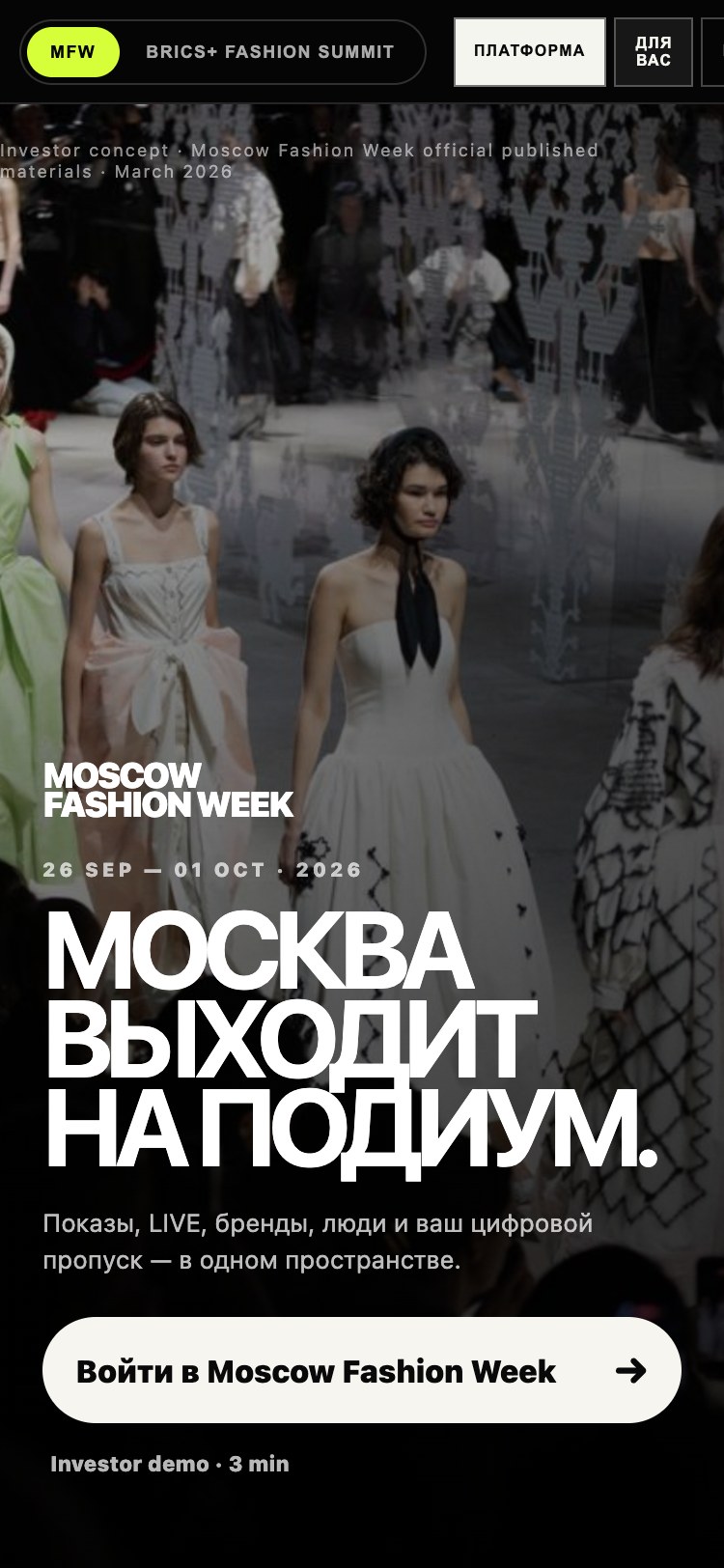
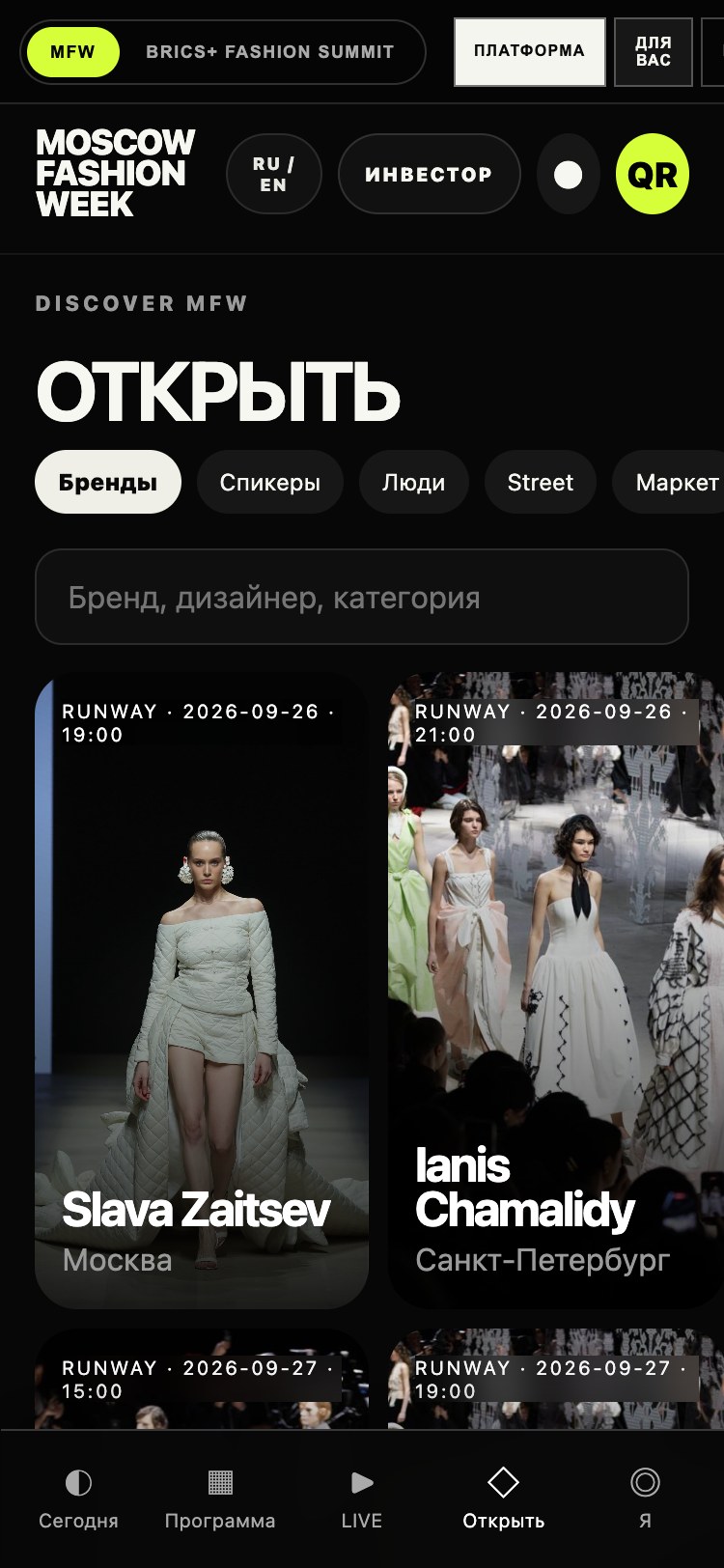
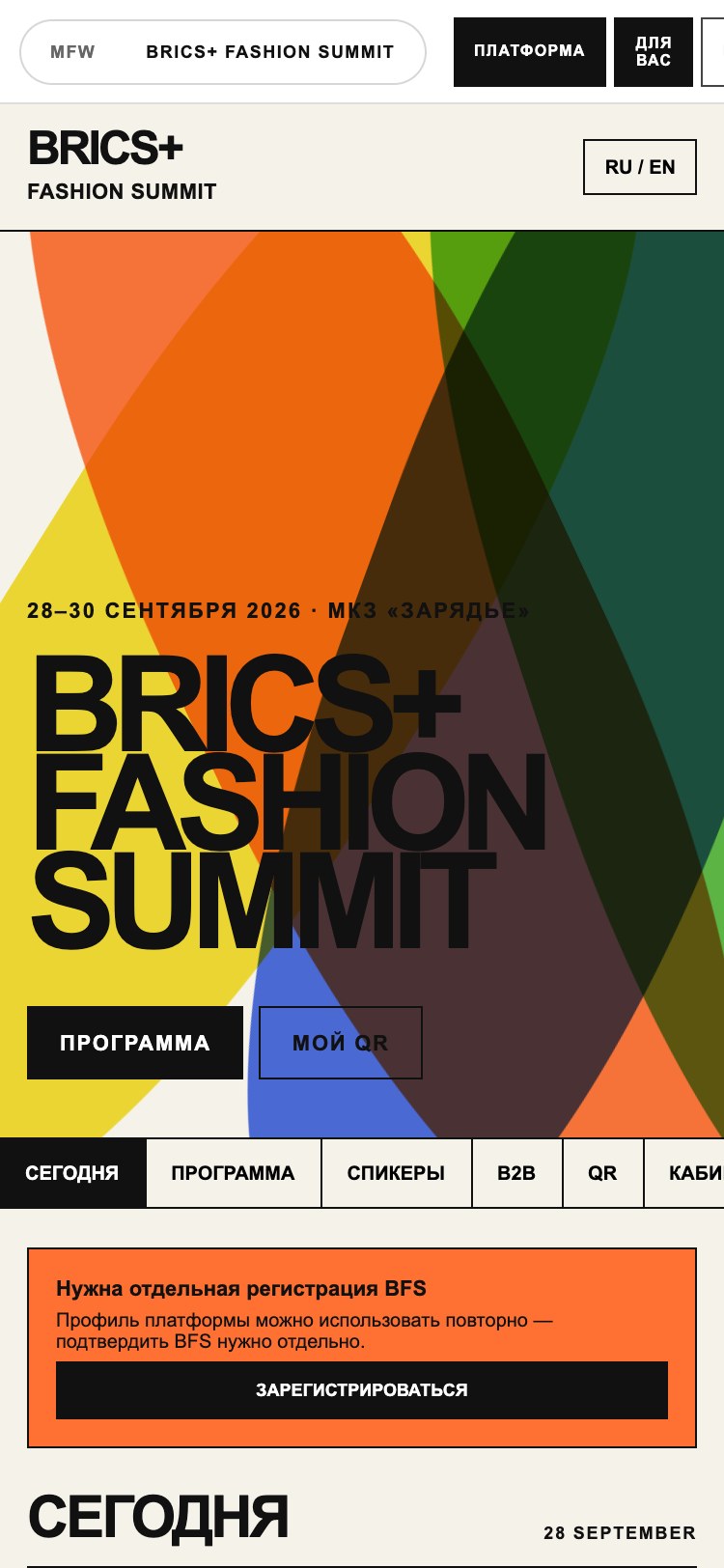
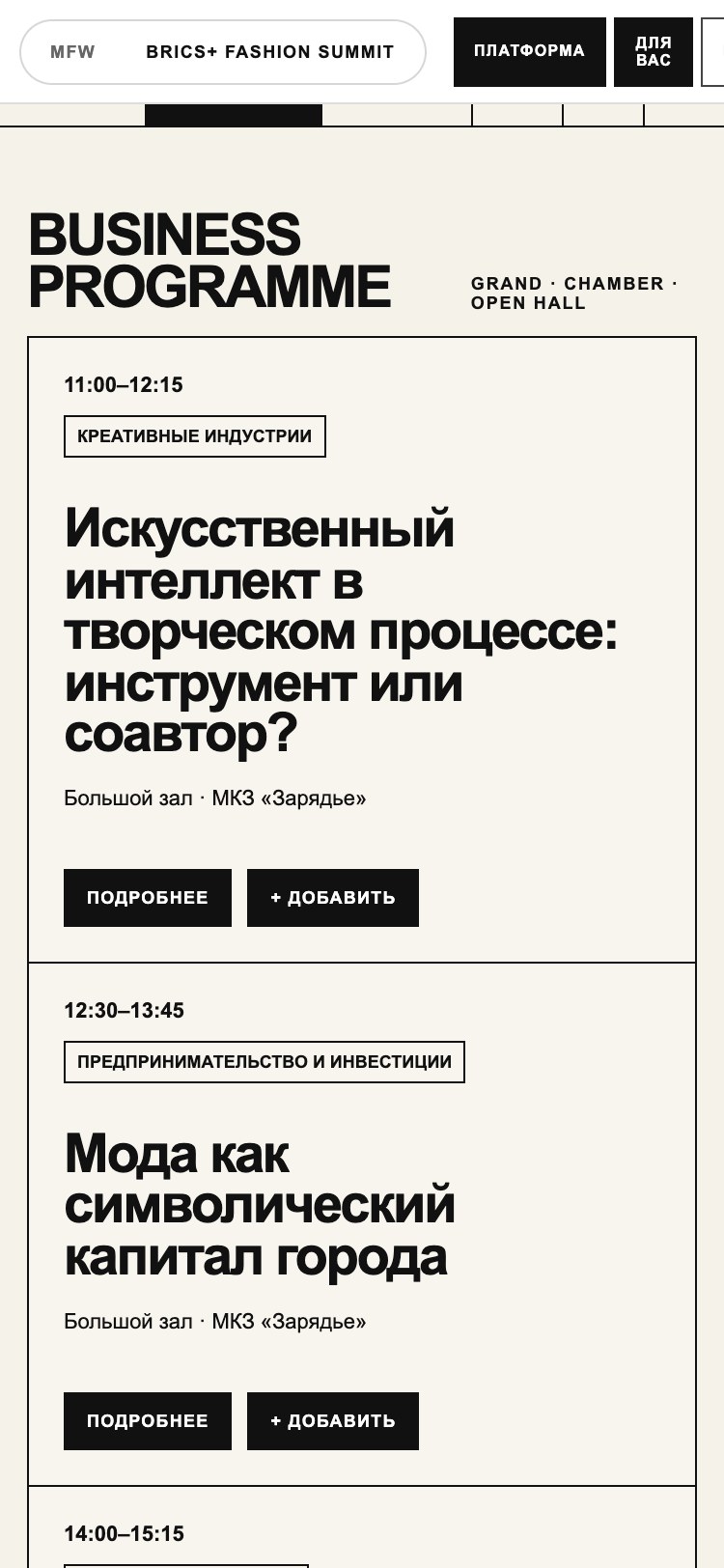
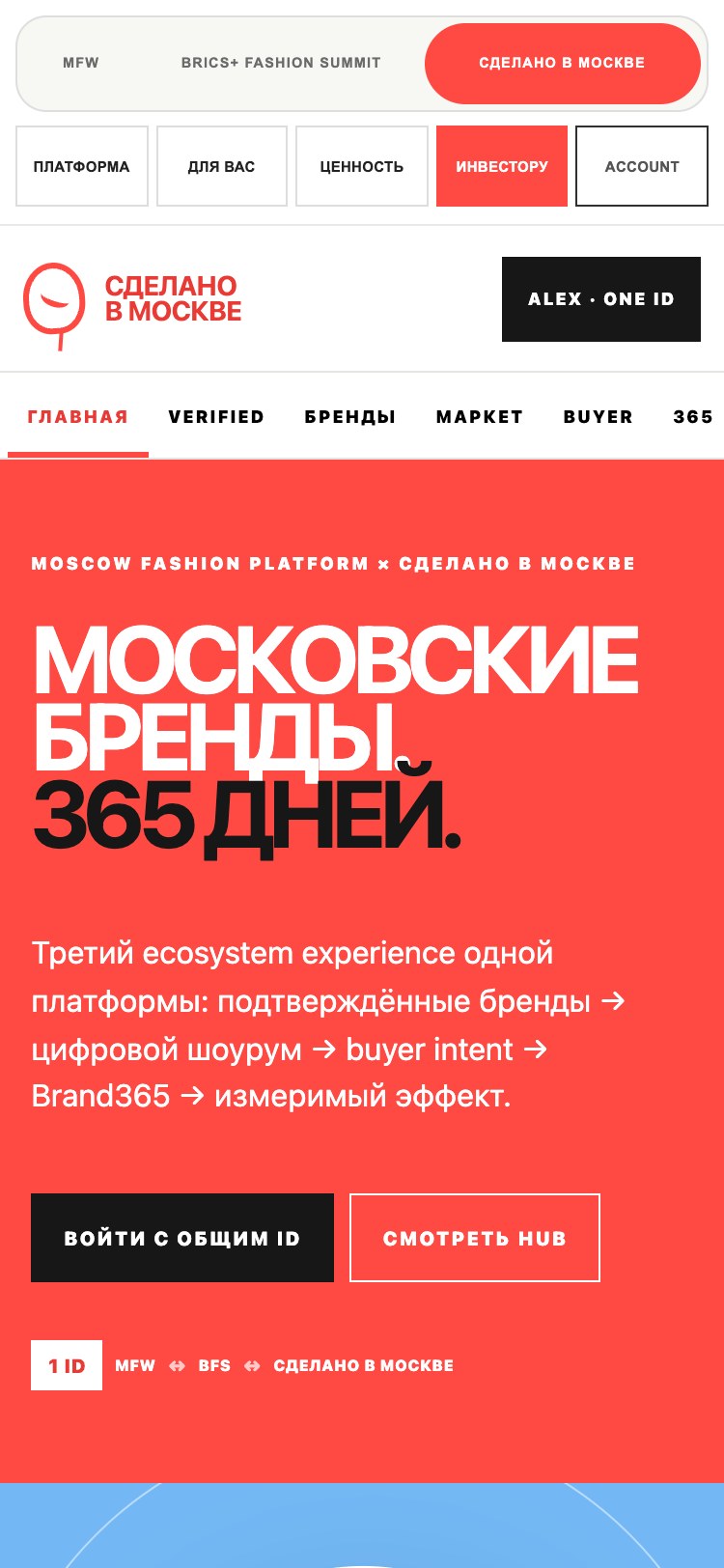
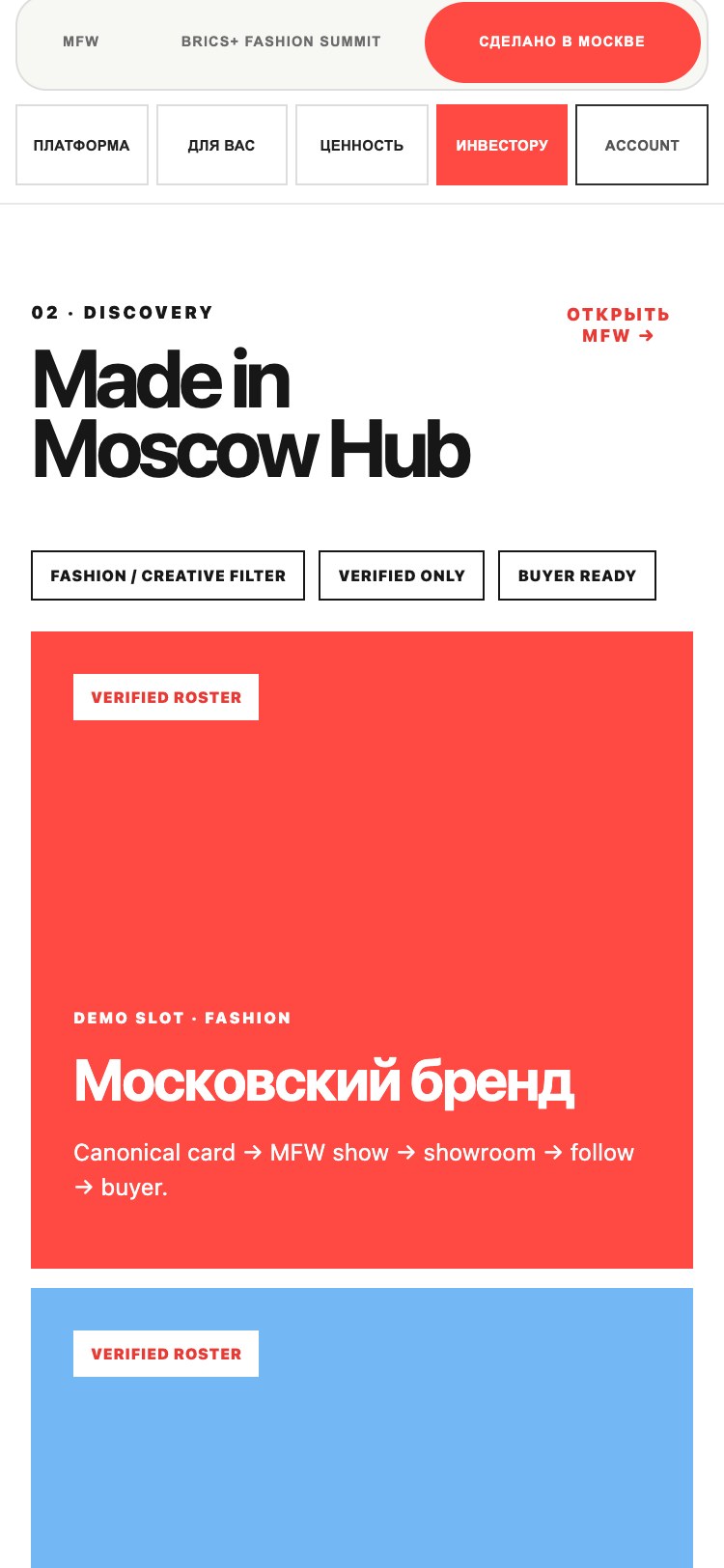
Tap a screenshot to open it full screen, then swipe through the rest.
08 — Get involved
If the idea appeals to you
We are looking for partners and organisers for MFW and BFS, and for brands and organisers for Made in Moscow. The platform could also suit other events; we plan to offer it to them, and it is not an agreement. If you represent an organiser, a venue, a brand or a sponsor, we would be glad to talk.